 Mangystau - Mars on Earth, Kazakhstan, a Series by Manish Lakhani — Glass
Mangystau, a hidden gem, is located in the southwest of Kazakhstan.
It is a kingdom of breathtaking journeys through the wild landscapes of Mangystau, a hidden…
glass.photo
Mangystau - Mars on Earth, Kazakhstan, a Series by Manish Lakhani — Glass
Mangystau, a hidden gem, is located in the southwest of Kazakhstan.
It is a kingdom of breathtaking journeys through the wild landscapes of Mangystau, a hidden…
glass.photo Trump’s Constitutional Dictatorship | Mark Danner
Maggie Haberman and Jonathan Swan’s inside account of the Trump administration portrays a president with a vast appetite for power but who repeatedly backs down when the costs of his actions become too high.
www.nybooks.com
Trump’s Constitutional Dictatorship | Mark Danner
Maggie Haberman and Jonathan Swan’s inside account of the Trump administration portrays a president with a vast appetite for power but who repeatedly backs down when the costs of his actions become too high.
www.nybooks.comAnd then there’s this:
 The Future, Made in China
China is competing with the U.S. for tech supremacy, and whoever wins will have extraordinary power to shape international politics. Evan Osnos reports from a Beijing that is being retooled to compete with Silicon Valley.
www.newyorker.com
The Future, Made in China
China is competing with the U.S. for tech supremacy, and whoever wins will have extraordinary power to shape international politics. Evan Osnos reports from a Beijing that is being retooled to compete with Silicon Valley.
www.newyorker.com“The current world order was built by a group of geniuses, mainly in the U.S., who hailed from Europe,” Rao said. “If Trump had maintained the order effectively, China would find it very hard to get through. Trump really helped us.”
Let’s hope that this is still the case:
America is not functioning well these days, but its political system, by design, gives the public more power to fix problems—if they choose to fix them.
This interview gives you an idea how badly we’re functioning right now
 Fresh Air for Aug. 5, 2026: Eric Lipton on Trump's conflicts of interest
Hear the Fresh Air program for Aug 05, 2026
www.npr.org
Fresh Air for Aug. 5, 2026: Eric Lipton on Trump's conflicts of interest
Hear the Fresh Air program for Aug 05, 2026
www.npr.orgBabylon Berlin Season 5 trailer dropped.
This is the last season and spans February and March 1933, the crucial time when Hitler seized power and the Weimar Republic died. Prime example of how things end up when rich power elites pursue their own interests and misjudge the situation, “it will be fine, we can control him”. Reminds me of something from not too long ago, what was it again…oh right, the first few links in this post.
Awesome conversation. I got a little distracted when they brought up “The Library of Babel”, the short story by Jorge Luis Borges and combinatorics. It’s like a Pavlov reflex for me when I hear combinatorics, and I started thinking about combinatorial identities and their delightful proofs instead of listening to the conversation. Things like
$$ (a + b)^n = \sum_{k = 0}^n a^k b^{n-k} \binom{n}{k} $$
which you prove combinatorially with words of size $n$ from an alphabet of $a$ vowels and $b$ consonants (both sides of the identity count the same thing, just in different ways).
Or
$$ \sum_{k = 1}^n k \binom{n}{k} = n 2^{n-1} $$
which is the number of ways to choose a team of any size from a set of $n$ players and choose a captain of the team.
Or
$$ \sum_{k = 0}^n \binom{n}{k}^2 = \binom{2 n}{n} $$
which is number of ways to select $n$ items from two disjoint sets of size $n$.
Anyways, I got back to the conversation. Didn’t understand the finer points they made in physics. Sean Carroll had a hopeful note at the end when commenting on the implications of LLMs in research physics. I’m fascinated by these LLM takes in all the creative fields, see also the essay from David Bessis on mathematics in the age of LLMs:
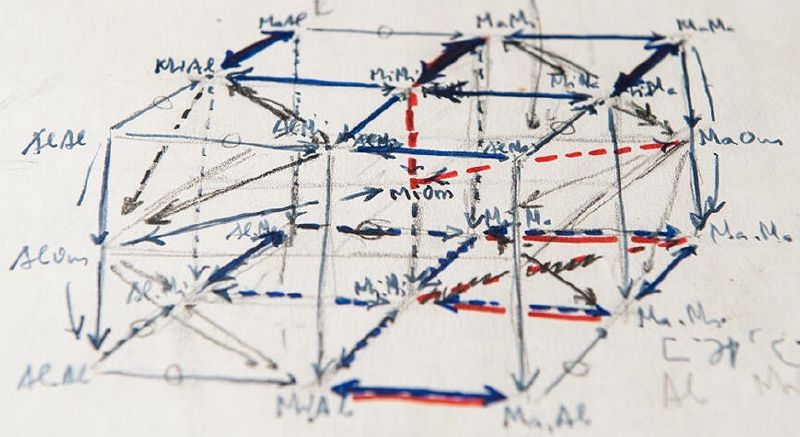 The fall of the theorem economy
How AI could destroy mathematics and barely touch it
davidbessis.substack.com
The fall of the theorem economy
How AI could destroy mathematics and barely touch it
davidbessis.substack.comJeff Dean and Sanjay Ghemawat are leaving Google
Four Prominent A.I. Researchers Leave Google to Start Their Own Company The researchers, who were instrumental in developing Google’s Gemini models and systems, have formed Discovery Loop. www.nytimes.comHere’s an older article about their friendship and their way of working using pair programming
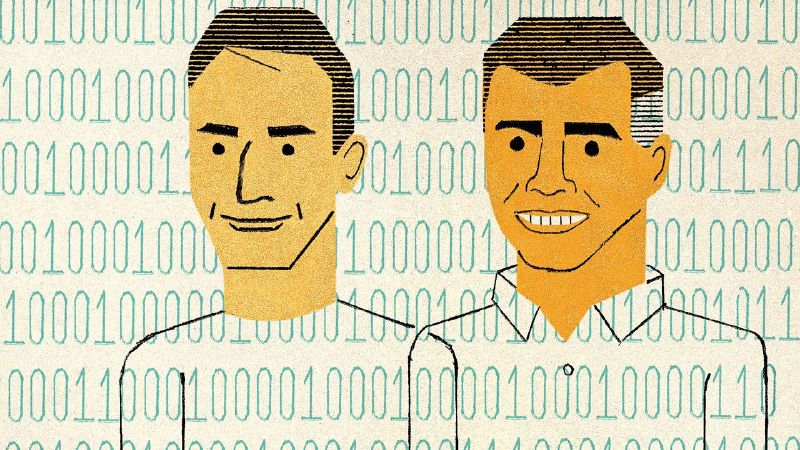 The Friendship That Made Google Huge
Coding together at the same computer, Jeff Dean and Sanjay Ghemawat changed the course of the company—and the Internet, James Somers writes.
www.newyorker.com
The Friendship That Made Google Huge
Coding together at the same computer, Jeff Dean and Sanjay Ghemawat changed the course of the company—and the Internet, James Somers writes.
www.newyorker.comEvery other Googler right now is trying to decide if they want to jump
Maybe this book helps with the decision
"An absolute must-read for anyone interested not just in big tech, but in what it takes to not lose your soul in modern-day America." —Naomi Fry, staff writer at The New Yorker A whip-smart, darkly funny, and timely memoir of one woman’s twelve years inside Google and her transformation from insider ...